Completion of the Green Innovator Academy 5th Term
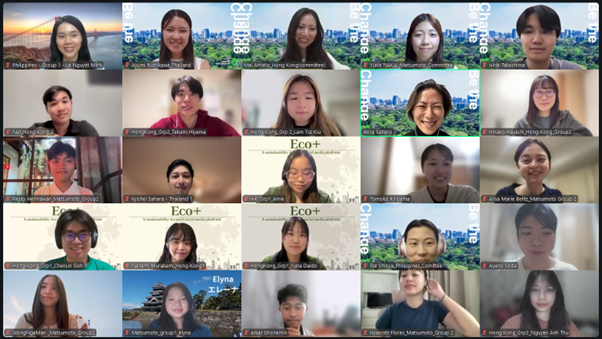
Green innovation successfully completed the “Green Innovator Academy” (GIA) on November 30, 2025, with a final presentation session marking the conclusion of the programme. GIA is a core initiative of the Green Innovator Project, which aims to foster 1,000 next-generation innovators who will lead the green transition to a decarbonised society by 2030.
More than 500 participants, including university and graduate students selected from Japan and abroad, as well as professionals from corporations, government ministries, and local municipalities, have learned the big picture, global trends and initiatives on Green Transformation (GX) and hands-on methodologies for creating practical approaches to systems-level innovation.
In this year, the student program partnered with the “ASEAN Youth Organisation” (AYO), the largest youth network in the ASEAN region, and the “Wofoo Leaders’ Network”, working in youth-led environmental education in Hong Kong. Through cross-cultural dialogue and the exploration of environmental challenges across Asia, participants strengthened their ability to drive GX across disciplines, generations, and borders.
This article highlights the solutions proposed by each team following fieldwork conducted in Matsumoto (Nagano, Japan), Hong Kong, Bangkok (Thailand), and Manila (Philippines).
―――
Japan (Matsumoto City, Nagano Prefecture)
Project Theme: How can we spread the civil climate action more among the citizens?
【Presentation Summary: Matsumoto Team ①】
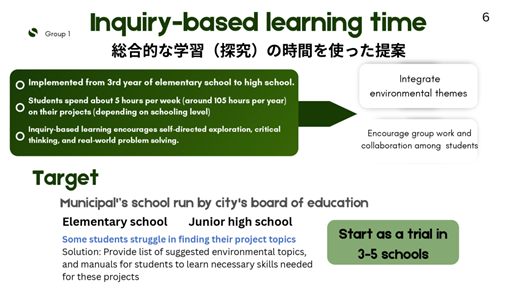
“Youth empowerment in Matsumoto City” – Increasing climate action among youths-
The team identified declining motivation among young people to engage in environmental action as a central bottleneck. In response, they proposed a policy framework that integrates environmental themes into inquiry-based learning within schools, while providing continued support through to the implementation of concrete actions.
By creating structured opportunities for students to translate learning into practice within the curriculum, the proposal aims to foster long-term, self-driven environmental engagement.
【Presentation Summary: Matsumoto Team ②】
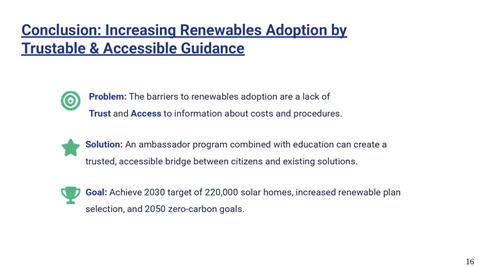
“Renewing Matsumoto City” -A Strategic Plan for Renewable Energy Utilization-
Focusing on the fact that the household sector accounts for approximately 30% of total CO2 emissions in Matsumoto City, the team proposed a strategy to accelerate renewable energy adoption. Key challenges identified included public distrust of so-called “zero-yen solar” schemes and limited access to reliable information.
To address these issues, they introduced the concept of Renewable Energy Ambassadors, who provides on-site consultations at local elementary schools and deliver educational programs on solar power. This model aims to enhance information transparency and foster greater public confidence in renewable energy adoption.
【Comments from the Reviewers】
While Suzuki-san raised questions regarding the feasibility of the proposals, both teams responded through well-structured explanations and constructive dialogue. Kitazawa-san from the same division also commended the proposals for being closely grounded in the realities and needs of local citizens.
Reviewers
- Hiroshi Suzuki, Manager of Environment and Clean Energy Division, Matsumoto City
- Minori Kitazawa, Environment and Clean Energy Division, Matsumoto City
Thailand Team(Bangkok)
Project Theme: How might we leverage digital technologies to promote sustainable urban living and responsible industrial practices, with a focus on youth engagement, cross-cultural collaboration, and regional identity building through digital innovation.
【Presentation Summary: Bangkok Team①】

“Digital Platform for Promoting Low-Carbon Behaviour among Youth: ASEAN Youth Carbon Network”
The team identified the rapid urbanisation occurring in Bangkok and other Southeast Asian cities, along with the resulting increase in CO2 emissions, as a key challenge.
To address this issue, they proposed the development of a digital platform called the “ASEAN Youth Carbon Network”, a digital platform designed to enable young people across ASEAN countries to track and reduce their carbon footprints using digital tools. The platform seeks to support youth-led initiatives and encourage regional collaboration toward decarbonisation.
【Presentation Summary: Bangkok Team②】
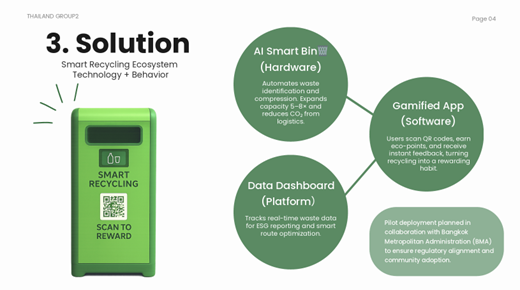
“SORTIFY” -Smart Recycling Ecosystem Technology+Behavior-
Through on-site observation of Bangkok’s streets, the team identified the city’s worsening waste management situation as a critical issue. In response, they proposed a recycling promotion system that combines AI technology with smart waste bins.
Beginning with a pilot implementation around university areas, the model aims to encourage recycling behaviour while generating positive environmental, social, and economic impacts at the city scale.
【Comments from the Reviewers】
Wiriya praised both teams for their ability to visualise carbon footprints and translate insights into practical urban and industrial applications. He also noted that the progression from problem identification to the AI-enabled smart bin solution was logical and easy to follow. Both teams were commended for their strong use of fieldwork and their commitment to applying technology to real-world policy challenges.
Reviewer
Wiriya Rattanasuwan, Climate Project Advisor, GHGs/CORSIA/Sustainability Report Verifier, South Pole
Hong Kong
Project Theme:How might we engage citizens, communities, and businesses to co-create circular solutions together?
【Presentation Summary:Hong Kong①】
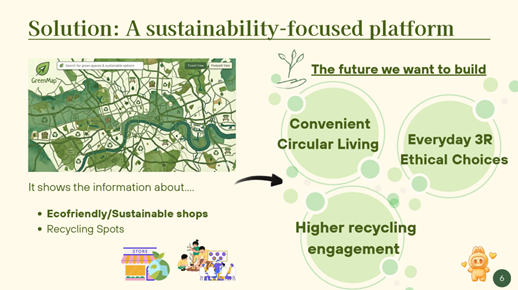
“Eco+: A Sustainability-Focused Social Media Platform”
The team identified the gap between environmental awareness and actual behaviour manifested in issues such as overconsumption and low recycling rates as a central challenge. Based on survey results primarily targeting university students, they proposed Eco+, a sustainability-oriented social media platform. By integrating recycling education, volunteer matching, mapping functions, and a point-based reward system, Eco+ aims to embed sustainable action into users’ everyday digital habits and encourage continuous behavioural change.
【Presentation Summary:Hong Kong②】
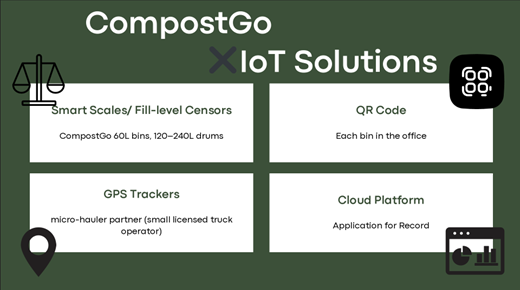
“CompostGo: A Circular Composting Platform for Hong Kong”
Addressing the approximately 3,400 tonnes of food waste generated daily in Hong Kong and the lack of robust data-tracking systems for corporate ESG reporting, the team proposed CompostGo Hong Kong, an IoT-enabled composting platform. Through smart scales, QR codes, and GPS tracking, the platform enables companies to collect ESG data aligned with HKEX reporting standards, while promoting a circular model for food waste utilisation.
【Comments from the Reviewers】
Paul praised Team ① for effectively increasing user motivation by embedding environmental action into everyday digital behaviour. Daniel raised questions regarding data accuracy, to which the team responded by outlining a phased PoC and A/B testing strategy.
For Team ②, Naomi commended the proposal’s strong practical orientation while posing questions about partner identification, data validation, and office-based implementation. The team addressed these points by detailing operational roles, collaboration with ESG consultants, and the feasibility of their logistics and tracking systems.
Reviewers
- Paul Chan, CEO Hanin Group, Founder, ESG School HK
- Naomi Chan, 2024 Chairman of Asia Pacific Development Council (JCI- Junior Chamber International)
- Daniel Lo, Founder & Director of Dash Consultancy & Management
Philipines (Manila)
Project Theme:How might we create green circular economy by accelerating youth Zero waste initiatives
【Presentation Summary: Manila①】
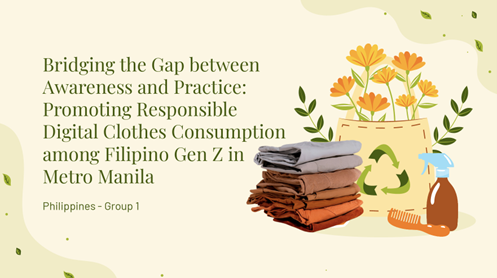
“Bridging the Gap between Awareness and Practice: Promoting Responsible Digital Clothes Consumption among Filipino Gen Z in Metro Manila”
The team focused on Generation Z, who make up more than one-third of the Philippine population and are major online consumers, and addressed the growing waste problem linked to fast fashion. They proposed an educational and social media-based strategy targeting Gen Z, developed in collaboration with university students.
Key measures included encouraging eco-friendly packaging and exploring digital clothing options, such as avatar-based fashion, to foster more sustainable consumption patterns.
【Presentation Summary: Manila②】
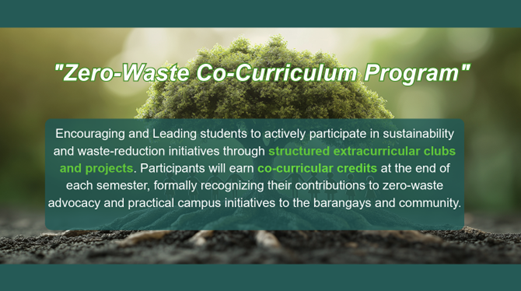
“Zero-Waste Co-Curriculum Policy for Quezon City University (QCU)”
The team proposed a Zero-Waste Co-Curricular Program aimed at fostering environmental innovators in Quezon City, Manila. Their strategy focused on motivating students to engage in zero-waste initiatives and providing practical support for implementation.
Key components of the proposal included establishing zero-waste–focused student clubs at QCU, inviting faculty advisors, forming partnerships with barangays (local administrative units), and introducing a system in which students can earn co-curricular credits through their participation.
【Comments from the Reviewers】
Marian noted that Team ①’s focus on packaging was both timely and appropriate, and encouraged reference to existing social media campaigns and educational models.
For Team ②, she praised the depth of their research and suggested the possibility of collaborating with institutions in Quezon City, adding that their proposal demonstrated a high level of practicality.
Reviewer
Marian Frances T. Ledesma, Zero Waste Campaigner, Greenpeace Southeast Asia – Philippines
―――
Students who participated shared the following reflections:
- We moved beyond theoretical knowledge to gain a practical and comprehensive understanding of sustainable development and green business models. Through the actual creation of a business plan, I developed the ability to apply concepts like ESG and the circular economy in a real-world context.
- I was able to build strong connections with highly motivated peers from across Asia. Exposure to diverse perspectives significantly broadened my worldview.
- When proposing a business model, I learned how to build credible financial projections, a field I initially found challenging, through meticulous research, which led to significant personal growth.
- I was able to form strong connections with highly motivated and talented peers from across Asia, including Japan, Hong Kong, Thailand, and Vietnam. The exposure to diverse perspectives was highly stimulating and significantly broadened my worldview.
- The international fieldwork provided a valuable opportunity to directly observe cutting-edge sites, such such as those utilizing AI and advanced waste management, greatly expanding my perspective.
- My leadership and communication skills dramatically improved through facilitating multicultural teams and pitching ideas to experts.
- I am confident that the knowledge and network gained through this program will be directly applicable to my future career, including work related to infrastructure after graduation.
In its fifth year, the programme expanded its reach across Asia, welcoming more than 40 students selected from nine countries. Through fieldwork-based learning focused on environmental challenges in each region, participants engaged in meaningful dialogue across diverse cultural perspectives. This collaborative process fostered deeper cross-border cooperation and mutual understanding, enabling participants to jointly explore solutions to shared challenges in Asia.
Name: Green Innovator Academy 5th term
Period: September 20 – November 30, 2025
Contents: Online lectures, fieldworks and Presentations
Participants: Around 40 students (selected from 9 countries/regions)
Organizer: Green innovation
Partners: ASEAN Youth Organization, Wofoo Leaders’ Network
Co-organizer: The Kamenori Foundation
この記事をシェアする


